How to Choose the Best High Court Advocate in Hyderabad? A Complete Guide
Choosing the right advocate for a High Court matter is an important decision. Whether your case involves a writ petition, criminal matter, civil dispute, service issue, property dispute, constitutional question, appeal, or another legal proceeding, the advocate you choose can play an important role in how your case is presented and managed.
If you are searching online for the best High Court advocate in Hyderabad, it is easy to become overwhelmed by advertisements, reviews and claims of experience. Instead of choosing an advocate solely because of the word “best,” it is better to evaluate their relevant experience, understanding of your legal issue, communication, professional approach and familiarity with the appropriate court procedures.
The High Court for the State of Telangana is located in Hyderabad and provides access to case-status information, cause lists, judgments, e-filing information and other judicial services. (Telangana High Court)
This guide explains the important factors you should consider before choosing a High Court advocate in Hyderabad.
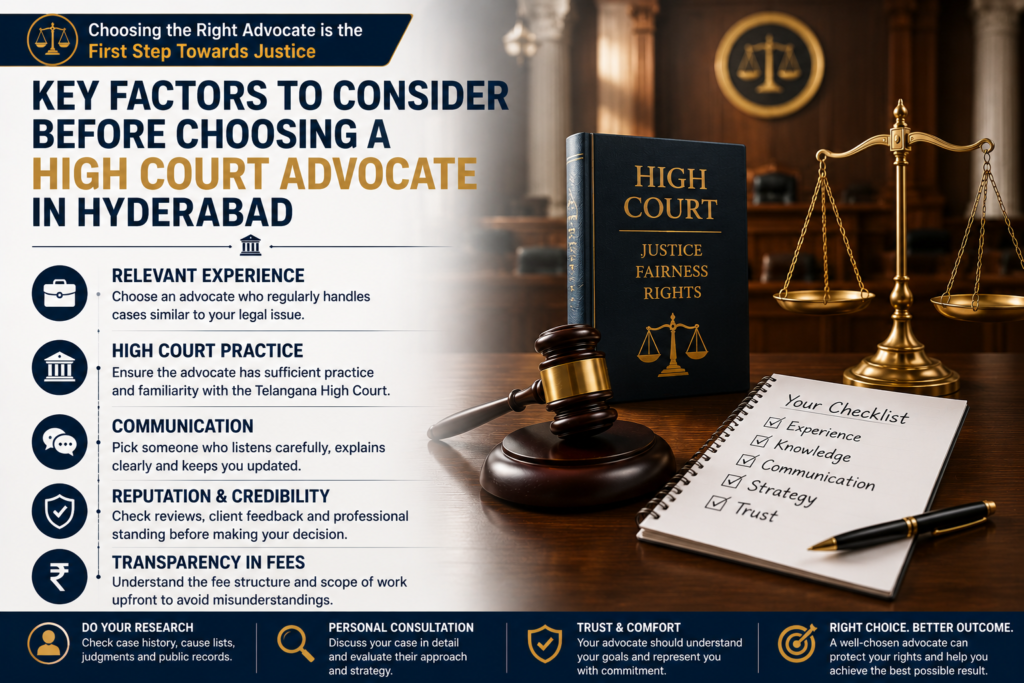
What Does a High Court Advocate Do?
A High Court advocate represents clients in matters that fall within the jurisdiction of the High Court.
Depending on the advocate’s practice areas, this may include:
- Writ petitions
- Criminal matters
- Civil appeals
- Criminal appeals
- Property-related proceedings
- Service matters
- Constitutional matters
- Bail-related proceedings
- Quashing petitions
- Matrimonial matters
- Commercial disputes
- Administrative matters
- Revision petitions
- Public law matters
Not every advocate handles every type of High Court proceeding. Therefore, experience relevant to your particular case is more important than simply choosing someone described as a “High Court lawyer.”
1. Identify the Exact Nature of Your Case
The first step is to understand what type of legal matter you have.
For example, your issue may involve:
Civil Matter
Property disputes, injunctions, contracts, money recovery, ownership or other civil issues.
Criminal Matter
FIR-related proceedings, bail, criminal appeals, revisions or other criminal proceedings.
Constitutional or Writ Matter
A challenge involving government action, administrative decisions or enforcement of legal rights may potentially involve writ jurisdiction.
Service Matter
Disputes relating to employment with government departments or public authorities may require specialized legal knowledge.
Family Matter
Certain matrimonial or family-related proceedings may reach the High Court through appeals, revisions or other appropriate proceedings.
Once you identify the nature of the dispute, you can look for an advocate who regularly handles similar matters.
2. Look for Relevant High Court Experience
One of the most important factors is relevant experience.
An advocate may have many years of general legal practice but limited experience in the specific type of case you have.
When speaking to a prospective lawyer, ask questions such as:
- Do you handle cases similar to mine?
- Have you handled matters before the Telangana High Court?
- What type of proceedings may be appropriate?
- What documents should I provide?
- What are the possible legal options?
- Are there any important procedural deadlines?
The purpose is not to demand a guaranteed result, but to understand whether the advocate has experience relevant to your situation.
The official eCourts High Court services also allow case searches using information such as party name, case number, advocate name, FIR number, Act and case type, making it possible to research publicly available case information where appropriate. (eCourt India High Courts Services)
3. Verify the Advocate’s Professional Credentials
Before engaging an advocate, consider verifying their professional details.
The Bar Council of India maintains rules and information concerning the legal profession, while advocates are enrolled through the relevant State Bar Council. The BCI also publishes information concerning practice verification and professional requirements. (Bar Council of India)
You can ask the advocate for relevant professional details, such as:
- Full name
- Enrollment details
- Areas of practice
- Professional experience
- Office details
- Relevant court practice
A professional legal consultation should also involve clear communication about the scope of representation.
4. Check Whether the Advocate Understands Your Case
A good initial consultation should not simply consist of the advocate telling you that your case will definitely succeed.
Instead, the advocate should try to understand:
- What happened?
- When did it happen?
- Who are the parties?
- What documents are available?
- Has any case already been filed?
- Has a notice or summons been received?
- What relief are you seeking?
- Are there previous orders or proceedings?
A lawyer who carefully examines these details is better positioned to provide meaningful legal advice.
5. Review Your Documents Before the Consultation
You can make your consultation more productive by organizing your documents beforehand.
Depending on your case, these may include:
- Court notices
- Previous judgments or orders
- FIR copies
- Complaints
- Agreements
- Sale deeds
- Property documents
- Bank records
- Legal notices
- Government communications
- Employment records
- Emails
- Relevant messages
- Previous pleadings
- Case numbers and CNR numbers
Do not hide important facts from your advocate, even if you believe they may negatively affect your case. Your lawyer needs an accurate understanding of the circumstances to provide appropriate legal advice.
6. Consider the Advocate’s Communication Style
Legal proceedings can take time and may involve multiple procedural stages.
Therefore, communication is an important part of the lawyer-client relationship.
Before choosing an advocate, consider whether they:
- Listen carefully
- Explain legal issues clearly
- Respond professionally
- Explain the next steps
- Tell you what documents are required
- Keep you informed about significant developments
- Avoid making unrealistic promises
You should feel comfortable asking reasonable questions about your case.
7. Understand the Fees and Scope of Work
Legal fees can vary depending on the nature and complexity of a matter.
Before engaging an advocate, clarify:
- Consultation fee
- Drafting charges
- Filing charges
- Appearance fees
- Hearing-related fees
- Documentation expenses
- Other applicable expenses
Also clarify what is included in the agreed professional fee.
A clear understanding at the beginning can help prevent misunderstandings later.
8. Be Careful About Guaranteed Results
One of the most important warning signs when choosing a lawyer is a guarantee of a particular court outcome.
No responsible advocate can guarantee that a court will decide a case in a particular way.
The outcome of litigation can depend on:
- Facts
- Evidence
- Applicable law
- Arguments
- Opposing party’s case
- Court findings
- Procedural developments
- Judicial discretion where applicable
A good advocate should explain the strengths, weaknesses and potential legal options rather than simply promising success.
9. Check Case Information Where Appropriate
Public court systems can be useful when researching legal proceedings.
The eCourts High Court services provide facilities to search cases using advocate name, party name, case number, filing number and other criteria. (eCourt India High Courts Services)
The Telangana High Court website also provides judicial information, case status, cause lists, judgments and e-filing-related resources. (Telangana High Court)
However, publicly available case information should be interpreted carefully. A case being listed in a particular advocate’s name does not by itself establish the quality, complexity or outcome of that advocate’s entire practice.
10. Choose an Advocate Based on Your Specific Legal Need
The “best” advocate for one person may not be the best choice for another.
For example:
Property dispute → Look for relevant property and civil litigation experience.
Criminal matter → Look for experience in criminal proceedings and the particular type of criminal case.
Writ petition → Look for experience in constitutional and administrative matters.
Service dispute → Consider an advocate experienced in service law and related proceedings.
Civil appeal → Look for experience in appellate litigation and the relevant subject matter.
This approach is generally more useful than selecting an advocate based solely on general popularity.
Why Choosing the Right High Court Advocate Matters
High Court litigation can involve detailed pleadings, legal research, procedural rules and substantial documentation.
The Telangana High Court publishes specific rules and resources relating to matters such as e-filing, writ proceedings, civil procedure and criminal procedure. (Telangana High Court)
An advocate familiar with the applicable procedure can help you understand:
- The appropriate legal remedy
- Relevant documents
- Filing requirements
- Procedural stages
- Possible arguments
- Potential risks
- Available remedies
This does not guarantee a particular result, but it can help ensure that your case is approached in a professional and informed manner.
Questions to Ask Before Hiring a High Court Advocate
Before finalizing your advocate, consider asking:
1. Have you handled cases similar to mine?
This helps determine whether their experience matches your legal issue.
2. What legal remedy may be available?
The answer may depend on the facts and documents.
3. What documents do you need?
Prepare the requested documents before the next consultation.
4. What are the important deadlines?
Some legal remedies have strict limitation or procedural requirements.
5. What are the likely stages of the case?
Understanding the process can help you plan realistically.
6. What are the professional fees?
Discuss the fee structure before proceeding.
7. What are the possible risks?
A good legal consultation should address both strengths and weaknesses.
Final Checklist for Choosing a High Court Advocate in Hyderabad
Before making your decision, consider this checklist:
✔ Relevant experience
✔ Practice before the Telangana High Court
✔ Knowledge of the specific area of law
✔ Clear communication
✔ Proper document review
✔ Transparent professional fees
✔ Realistic legal assessment
✔ Professional conduct
✔ Availability for important updates
✔ No unrealistic guarantee of success
Final Thoughts
Finding the best High Court advocate in Hyderabad is not simply about choosing the lawyer with the highest number of advertisements, reviews or online claims.
The more important question is:
“Is this advocate suitable for my particular legal problem?”
Look for relevant High Court experience, professional credentials, knowledge of your area of law, clear communication and a realistic approach to your case.
If you are facing a High Court matter in Hyderabad, obtaining an initial legal consultation can help you understand your available options before taking the next step.
Professional legal advice should always be based on the facts, documents and circumstances of your individual case.
Frequently Asked Questions
Who is the best High Court advocate in Hyderabad?
There is no single objectively “best” advocate for every type of case. The appropriate advocate depends on the subject matter, legal remedy, relevant experience and circumstances of the case.
How can I verify a High Court advocate?
You can ask for professional enrollment details and review publicly available court information where appropriate. eCourts provides case-search facilities including searches by advocate name and other case details. (eCourt India High Courts Services)
Can any advocate appear before the High Court?
Eligibility to practice and appear before courts is governed by applicable legal and professional requirements. The Bar Council of India and relevant State Bar Councils regulate the legal profession and related requirements. (Bar Council of India)
How much does a High Court advocate charge in Hyderabad?
Fees vary depending on the advocate, type and complexity of the case, drafting requirements, number of hearings and other factors. Discuss the fee structure directly with the advocate before engaging their services.
Should I choose a Senior Advocate?
Not necessarily. A Senior Advocate may be appropriate for some matters, while another advocate with strong experience in your particular subject area may be more suitable for others. The choice should depend on the needs of your case.