Best Cheque Bounce Lawyer in Hyderabad: A Complete Guide to Section 138 Cases
A cheque is commonly used for business transactions, loans, personal payments, property transactions, and other financial obligations. When a cheque is presented to the bank and returned unpaid, it can create significant financial and legal problems for the person who issued it and the person who received it. If you have received a cheque that has been dishonoured, you may be searching for the best cheque bounce lawyer in Hyderabad to understand what legal steps can be taken to recover the money.
Cheque dishonour cases are commonly dealt with under Section 138 of the Negotiable Instruments Act, 1881. The law provides a specific legal framework where a cheque issued towards a legally enforceable debt or liability is dishonoured for reasons covered by Section 138 and the statutory requirements are satisfied.
Advocate K R Sunil Kumar provides professional legal assistance relating to cheque bounce matters, legal notices, recovery proceedings, and related disputes in Hyderabad.
This guide explains the basic process, important timelines, and why obtaining legal advice can be important in a cheque dishonour matter.
What Is a Cheque Bounce Case?
A cheque bounce, commonly called cheque dishonour, occurs when a cheque presented for payment is returned unpaid by the bank.
One situation specifically addressed by Section 138 is where a cheque issued for the discharge, wholly or partly, of a legally enforceable debt or other liability is returned unpaid because the available funds are insufficient or the cheque amount exceeds the arrangement with the bank.
However, not every returned cheque automatically results in an offence under Section 138.
The statutory conditions and timelines must be satisfied.
This is one reason why consulting a cheque bounce advocate promptly can be useful.
What Is Section 138 of the Negotiable Instruments Act?
Section 138 of the Negotiable Instruments Act, 1881 deals with dishonour of certain cheques for insufficiency of funds or where the cheque amount exceeds the arrangement with the bank.
Under the section, the cheque must be presented within the applicable period, a written demand notice must be issued within the statutory period after receiving information about dishonour, and the drawer must fail to make payment within the prescribed period after receiving the notice.
The section provides for punishment that may extend to two years’ imprisonment, a fine that may extend to twice the cheque amount, or both, subject to the statutory requirements being established.
Because cheque bounce proceedings involve specific procedural requirements, missing an important deadline can affect the legal remedy available.
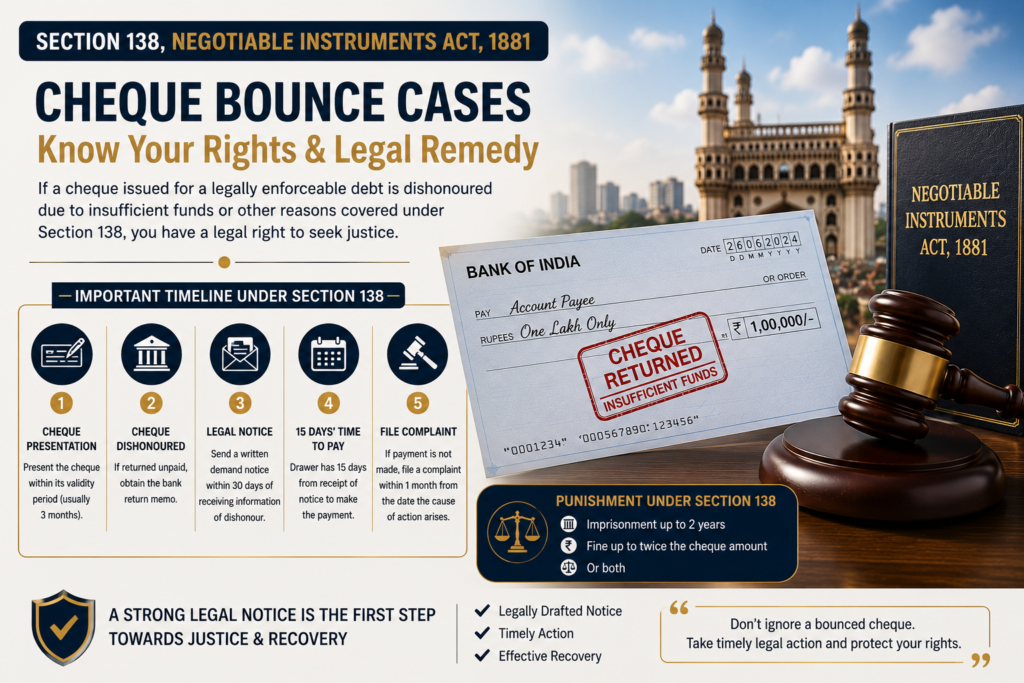
Important Timeline in a Cheque Bounce Case
Understanding the timeline is one of the most important aspects of a Section 138 matter.
Step 1: Present the Cheque
The cheque should be presented within its applicable validity period.
The Negotiable Instruments Act refers to presentation within six months or within the cheque’s validity period, whichever is earlier. In practice, RBI directions provide that banks should not make payment of cheques presented beyond three months from the date of the instrument.
Step 2: Receive the Bank Return Information
If the bank returns the cheque unpaid, obtain and preserve the cheque return memo and related bank records.
Step 3: Send the Legal Notice
Section 138 requires the payee or holder in due course to make a written demand for payment within 30 days of receiving information from the bank about the return of the cheque unpaid.
Step 4: Wait for the Statutory Period
The drawer is given 15 days from receipt of the notice to make payment under Section 138.
Step 5: Consider Filing the Complaint
If the statutory requirements are satisfied and payment is not made, a complaint may be filed in accordance with the applicable provisions.
Section 142 provides that a Section 138 complaint must generally be made by the payee or holder in due course and within one month from the date on which the cause of action arises, subject to the court’s power to condone delay where sufficient cause is shown.
Because the calculation of these dates can be important, professional legal advice should be obtained rather than relying on a general online timeline.
Why Is a Cheque Bounce Legal Notice Important?
A legal notice is an important statutory step in a Section 138 proceeding.
The notice generally demands payment of the cheque amount and informs the drawer about the dishonour and the legal consequences of failing to make payment.
A properly prepared notice should accurately address relevant matters such as:
- Cheque details
- Cheque amount
- Date of cheque
- Bank details
- Date of dishonour
- Reason for return
- Underlying debt or liability
- Demand for payment
- Applicable legal provisions
- Statutory timeline
A mistake in the notice or failure to comply with the statutory requirements can create complications.
Common Reasons for Cheque Dishonour
Cheques may be returned unpaid for different reasons, including:
- Insufficient funds
- Exceeding the arrangement with the bank
- Account-related issues
- Stop-payment instructions
- Signature-related issues
- Technical or banking reasons
- Other reasons mentioned in the bank’s return memo
Whether a particular dishonour attracts Section 138 depends on the facts and the statutory requirements.
Therefore, the reason stated in the bank return memo should be carefully examined.
What Is a Legally Enforceable Debt?
Section 138 specifically refers to a cheque issued for the discharge, wholly or partly, of a legally enforceable debt or other liability.
Examples can include certain:
- Loans
- Business dues
- Unpaid invoices
- Advances
- Contractual payments
- Other legally enforceable financial obligations
The nature of the underlying transaction and available evidence can be important in determining the legal position.
A cheque bounce lawyer can review documents such as agreements, invoices, bank statements, correspondence, receipts, and other relevant evidence.
Evidence and Documents for a Cheque Bounce Case
If you are dealing with a cheque dishonour matter, preserve all relevant records.
These may include:
- Original cheque
- Cheque return memo
- Bank statements
- Legal notice
- Postal receipt
- Tracking information
- Loan agreement
- Invoice
- Payment records
- Emails
- WhatsApp or other relevant communications
- Acknowledgment of debt
- Account statements
- Agreements between the parties
The documents required can vary depending on the circumstances.
Keeping a complete record can help your advocate assess the matter more effectively.
How a Best Cheque Bounce Lawyer Can Help
A cheque bounce advocate can assist at different stages of the dispute.
Legal Assessment
The advocate can review the cheque, bank return memo, underlying transaction, and available evidence.
Legal Notice
The lawyer can prepare a statutory demand notice based on the facts and applicable law.
Limitation and Timelines
The advocate can help calculate important statutory dates and identify procedural requirements.
Complaint Proceedings
Where appropriate, the lawyer can assist with preparing and filing the complaint.
Court Representation
An advocate can represent the client during applicable court proceedings.
Settlement Assistance
If the parties are willing to resolve the dispute, the lawyer may assist with legally appropriate settlement discussions.
What If You Received a Cheque for a Loan?
Loan-related cheque bounce cases are common.
For example, suppose a person borrowed money and issued a cheque towards repayment. If the cheque is dishonoured, the lender may need to consider the legal remedies available under the circumstances.
The lender should preserve evidence showing:
- The amount advanced
- Date of payment
- Purpose of the payment
- Loan agreement, if any
- Communications between the parties
- Cheque details
- Bank return memo
- Other evidence supporting the transaction
A lawyer can review the complete record and explain the available options.
What If a Business Cheque Bounces?
Cheque dishonour can also arise from business transactions.
Businesses may receive cheques towards:
- Outstanding invoices
- Supply of goods
- Services
- Contractual payments
- Advances
- Commercial transactions
A cheque bounce lawyer can review the commercial documents and advise on the appropriate legal course.
Where companies or other entities are involved, additional legal considerations may apply.
How to Choose the Best Cheque Bounce Lawyer in Hyderabad
Searching for the best cheque bounce lawyer in Hyderabad does not necessarily mean choosing the lawyer with the most advertisements or online claims.
Instead, consider:
Relevant Experience
Look for an advocate familiar with cheque dishonour and Section 138 proceedings.
Understanding of Procedure
Cheque bounce cases involve statutory timelines and procedural requirements.
Clear Communication
Your lawyer should explain the process and important deadlines clearly.
Document Review
The advocate should examine the underlying transaction and supporting evidence.
Realistic Legal Advice
Be cautious of anyone promising a guaranteed result in a legal proceeding.
Transparent Professional Fees
Discuss applicable legal fees and court-related expenses before proceeding.
Why Choose Advocate K R Sunil Kumar?
Advocate K R Sunil Kumar provides professional legal assistance to individuals and businesses dealing with cheque dishonour and related financial disputes in Hyderabad.
Legal assistance may include:
- Cheque bounce legal notices
- Section 138 proceedings
- Cheque dishonour disputes
- Recovery-related legal proceedings
- Loan-related cheque disputes
- Business payment disputes
- Legal documentation
- Court representation
Every cheque bounce matter depends on its own facts, documents, statutory timelines, and legal circumstances. Therefore, the appropriate strategy should be determined after reviewing the individual case.
Frequently Asked Questions About Cheque Bounce Cases
What should I do after my cheque is bounced?
Preserve the original cheque, bank return memo, and transaction records, and obtain legal advice promptly because Section 138 contains specific statutory timelines.
How long do I have to send a cheque bounce notice?
Section 138 requires the written demand notice to be issued within 30 days of receiving information from the bank regarding the return of the cheque unpaid.
How long does the drawer get to make payment after receiving the notice?
The drawer has 15 days from receipt of the notice to make the payment contemplated by Section 138.
What happens if the drawer does not pay after receiving the notice?
Subject to satisfying the statutory requirements, the payee or holder in due course may consider filing a complaint under the applicable provisions. Section 142 sets out requirements concerning cognizance and the time for making the complaint.
Can I recover money through a cheque bounce case?
A Section 138 proceeding can have consequences for cheque dishonour where its statutory requirements are met. Other civil or contractual remedies may also be relevant depending on the underlying transaction.
Can a cheque bounce matter be settled?
Section 138 offences are compoundable under Section 147 of the Negotiable Instruments Act. The appropriate settlement approach depends on the circumstances of the case.
Get Legal Guidance for Your Cheque Bounce Matter in Hyderabad
A bounced cheque can turn an ordinary financial dispute into a serious legal matter. The most important steps are often taken before a case reaches the courtroom—preserving evidence, understanding the statutory timeline, preparing the legal notice correctly, and choosing an appropriate legal remedy.
If you are searching for a cheque bounce lawyer in Hyderabad, Advocate K R Sunil Kumar can provide professional legal assistance relating to cheque dishonour, Section 138 proceedings, legal notices, and related recovery matters.
Do not ignore a cheque return memo or delay taking legal advice when statutory deadlines may be running.
Get professional legal guidance and understand your options before taking the next step.
Legal Disclaimer
This article is intended for general educational and informational purposes only and does not constitute legal advice. Cheque bounce cases are fact-specific, and the applicable legal position can depend on the documents, transaction, dates, bank records, statutory requirements, and other circumstances. Readers should consult a qualified advocate for advice relating to their individual matter. No particular outcome is guaranteed.
Get Professional Legal Guidance for Your Cheque Bounce Matter in Hyderabad